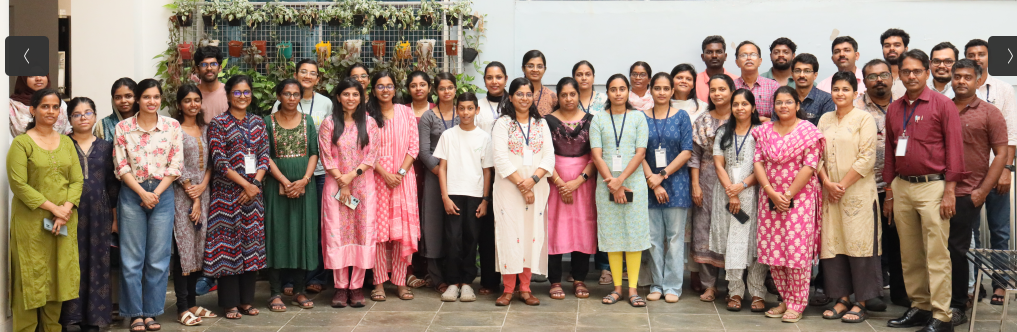
The CLC Lab IIIT Kottayam recently organized a comprehensive workshop on Graph Neural Networks (GNN), from May 25-29, 2026. The five-day event aimed to bridge the gap between core theoretical concepts and practical applications. Faculty members and research scholars attended the sessions in offline mode, making the event highly interactive. Here is a day-by-day breakdown of how the workshop unfolded.
Day 1: Foundations of Graph Machine Learning
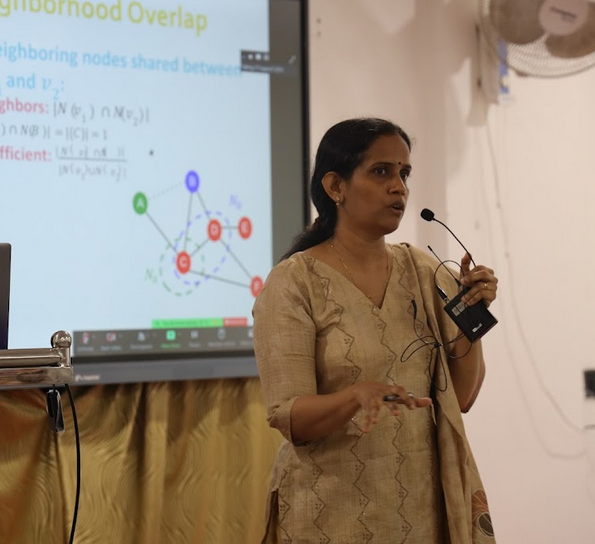
The workshop commenced with an engaging session on the motivation behind Graph Machine Learning. The speakers explained the necessary paradigm shift from traditional machine learning toolboxes to graph-structured data. They highly emphasized essential graph properties like permutation invariance. The second morning session shifted focus toward traditional graph statistics. Participants learned how to hand-craft features from graph data using concepts like centrality measures, clustering coefficients, and graphlets. In the afternoon, a hands-on lab session allowed everyone to implement these foundational topics practically.
Day 2: Node Embeddings and Neural Network Essentials
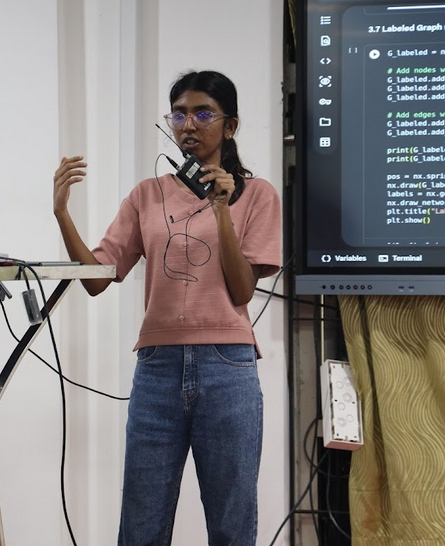
The second day focused heavily on node embedding techniques and core neural network architectures. The instructors introduced shallow node embedding methods, including DeepWalk, random walks, and the Node2Vec algorithm. To build a solid conceptual bridge toward modern GNNs, the afternoon sessions covered essential neural network fundamentals. This ensured that all participants, regardless of their background, were on the same page regarding deep learning basics.
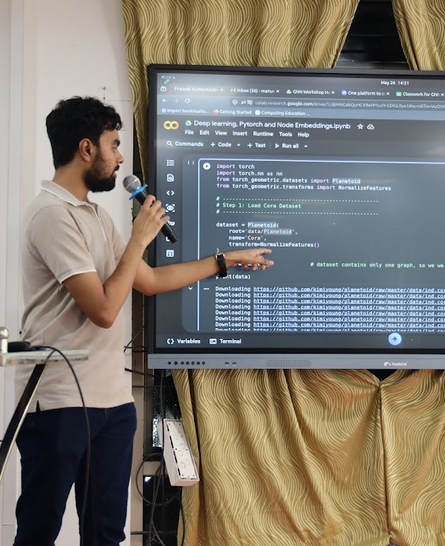
Day 3: Message Passing and Graph Convolution Networks
The third day dove straight into the heart of modern GNNs, starting with the neural message passing framework. This was followed by a detailed theoretical discussion on spectral convolution and Graph Convolutional Networks (GCN). The afternoon lab session was highly practical and result-oriented. Participants implemented GCNs for critical tasks like node classification and link prediction using standard benchmark datasets.
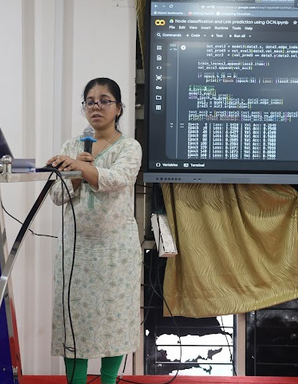
Day 4: Advanced GNN Architectures
Advanced GNN architectures took center stage on the fourth day. The day began by addressing the uniform weight issue inherent in standard GCNs, leading directly into Graph Attention Networks (GAT). To introduce a more global attention mechanism, the speakers presented the Graphormer architecture. The subsequent sessions on Graph Pooling and GraphSAGE further expanded the horizon of what GNNs can achieve with large-scale data.
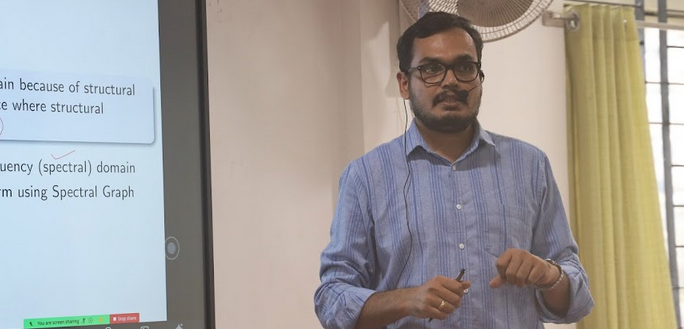
Day 5: Applications, Research Showcases, and Way Forward
The final day opened with a session on unsupervised training of GNNs using Graph Autoencoders (GAE). Following this, CLC Lab researchers presented their ongoing cutting-edge work. Amrita discussed GNNs for breast cancer subtype prediction, while Navneeth showcased GNNs for knowledge graph embedding in traditional performing arts. The lab team also presented their work on GNNs for cell clustering. Active participants like Dr. Archuda, Ms. Anjana, and Dr. Setheesh also shared and discussed their respective research ideas. The workshop concluded with a comprehensive summary session tracking current GNN literature across theory, models, and applications, alongside key resources for future study.
Around 45 offline participants, including faculty and enthusiastic research scholars, attended the workshop. Dr. Manu and Dr. Nandini handled the theoretical sessions. The intensive lab sessions were managed efficiently by Amrita, Navneeth, and Preveena. Overall, the participants shared very positive feedback, noting that the workshop helped them thoroughly understand GNNs right from the fundamentals.